

9th Class Biology Pairing Scheme 2027, Punjab Boards
The 9th Class Biology Pairing Scheme 2027 helps students understand the expected paper structure, chapter-wise MCQ distribution, short-question groups, and long-question choices for Punjab Board examinations. According to the supplied scheme, the paper carries 60 marks, including 12 MCQs, 30 marks of short questions, and 18 marks of long questions.
Students can use this scheme to organize revision and identify the chapters included in each question group. For effective preparation, study the prescribed textbook, practise its exercises, and use the pairing scheme alongside the latest examination instructions.
Class 9 Biology Paper Pattern 2027
| Paper Section | Marks | Details |
|---|---|---|
| MCQs | 12 | 12 questions, 1 mark each |
| Short Questions | 30 | Three groups, 10 marks each |
| Long Questions | 18 | Attempt 2 questions, 9 marks each |
| Total | 60 | Complete Biology paper |
Important: The supplied overview says there are 10 short questions worth 3 marks each, but the detailed distribution says to attempt five questions from each of three groups, with 10 marks per group. These details do not match. Confirm the number of questions and marks per question against the original scheme before publishing the final paper pattern.
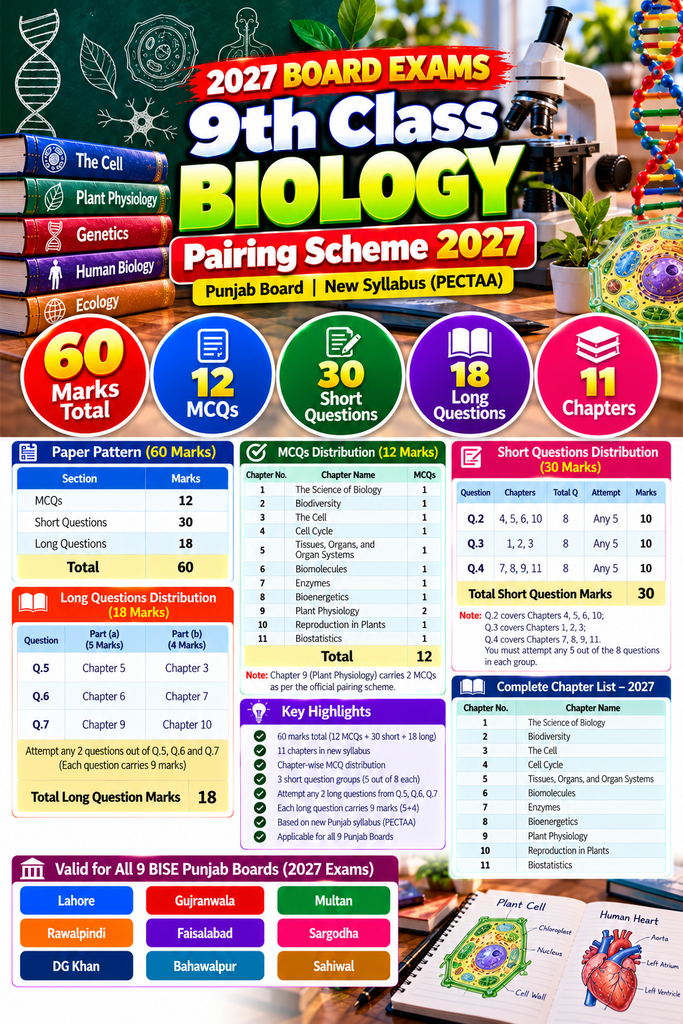
9th Class Biology MCQs Distribution 2027
The following table presents the chapter-wise distribution of the 12 MCQs according to the supplied pairing scheme.
| Chapter | Chapter Name | MCQs |
|---|---|---|
| 1 | The Science of Biology | 1 |
| 2 | Biodiversity | 1 |
| 3 | The Cell | 1 |
| 4 | Cell Cycle | 1 |
| 5 | Tissues, Organs, and Organ Systems | 1 |
| 6 | Biomolecules | 1 |
| 7 | Enzymes | 1 |
| 8 | Bioenergetics | 1 |
| 9 | Plant Physiology | 2 |
| 10 | Reproduction in Plants | 1 |
| 11 | Biostatistics | 1 |
| Total | 12 |
Chapter 9, Plant Physiology, carries two MCQs in the provided distribution. Give this chapter extra attention during objective preparation, but revise all the other chapters as well because each has at least one MCQ.
Class 9 Biology Short Questions Pairing Scheme 2027
The supplied scheme divides short questions into three groups covering all 11 chapters.
| Question | Chapters Included | Attempt | Marks |
|---|---|---|---|
| Q.2 | Chapters 4, 5, 6, 10 | Any 5 of 8 | 10 |
| Q.3 | Chapters 1, 2, 3 | Any 5 of 8 | 10 |
| Q.4 | Chapters 7, 8, 9, 11 | Any 5 of 8 | 10 |
| Total | Chapters 1 to 11 | 15 questions | 30 |
Prepare each group separately and practise questions from every chapter. Focus on definitions, biological processes, functions, differences, labelled diagrams, and textbook exercises where relevant. Although the choice of questions may give you flexibility in the examination, skipping entire chapters can leave you unprepared for questions in other sections.
9th Class Biology Long Questions Pairing Scheme 2027
The supplied scheme lists three long-question groups. Each complete question carries 9 marks, divided into part (a) worth 5 marks and part (b) worth 4 marks.
| Question | Part (a) | Part (b) |
|---|---|---|
| Q.5 | Chapter 5: Tissues, Organs, and Organ Systems | Chapter 3: The Cell |
| Q.6 | Chapter 6: Biomolecules | Chapter 7: Enzymes |
| Q.7 | Chapter 9: Plant Physiology | Chapter 10: Reproduction in Plants |
Students are expected to attempt any two complete questions from Q.5, Q.6, and Q.7, giving a total of 18 marks. Practise both parts of each question group instead of preparing only one chapter from a pair.
Check the original pairing scheme or your teacher’s instructions to confirm the exact chapter allocation and marks before treating this table as final.
How to Prepare for the 9th Class Biology Board Exam 2027
The pairing scheme can help you plan your preparation, but Biology requires more than memorizing expected questions. Students need to understand biological processes, learn scientific terminology, explain functions, compare concepts, and practise diagrams. A balanced preparation plan will help you handle different types of questions.
1. Prepare MCQs from All 11 Chapters
The objective section carries 12 marks according to the supplied scheme. Start by revising the important definitions, scientific terms, functions, examples, and basic concepts from each chapter.
Chapter 9, Plant Physiology, has two MCQs in the supplied distribution. Give this chapter additional attention, particularly the processes and concepts covered in your prescribed textbook. However, do not ignore the other chapters, as each contributes at least one MCQ.
Practise textbook MCQs without checking the answers first. When you choose an incorrect option, revisit the relevant topic and understand the reason behind the correct answer. Maintain a short revision list of difficult terms, biological facts, and concepts so you can review them before the examination.
2. Prepare Short Questions in Three Groups
Divide your short-question preparation according to the supplied pairing scheme:
- Q.2: Chapters 4, 5, 6, and 10
- Q.3: Chapters 1, 2, and 3
- Q.4: Chapters 7, 8, 9, and 11
Practise questions from every chapter within each group. For definition-based questions, learn the key meaning and use accurate biological terminology. For questions about functions or processes, explain the main steps in a logical order. For comparison questions, identify the relevant similarities or differences and present them clearly.
Pay attention to questions that ask about the structure and function of cells, tissues, organs, enzymes, and plant processes. Practise writing answers independently instead of simply reading the textbook solutions. Keep track of questions you find difficult and revisit them during your next revision session.
3. Give Proper Attention to Long Questions
Long questions account for 18 marks in the supplied pattern. The three groups cover different combinations of chapters:
- Q.5: Tissues, Organs, and Organ Systems, with The Cell
- Q.6: Biomolecules, with Enzymes
- Q.7: Plant Physiology, with Reproduction in Plants
You are expected to attempt two complete questions from the three groups. Prepare both parts of each group so that you have alternatives if one question is difficult.
Practise explaining biological processes step by step. Learn important structures, functions, classifications, and examples from the prescribed textbook. Where a question requires a diagram, practise drawing it neatly, labelling the important parts, and understanding what each part does. Do not rely only on memorized paragraphs; make sure you understand the process being described.
4. Practise Biological Diagrams and Labelling
Diagrams can help you explain biological structures and processes clearly when they are required by a question. Review the important diagrams in your textbook and practise drawing them without copying directly from the page.
Focus on correct proportions, clear outlines, accurate labels, and neat presentation. Learn the functions of the labelled parts as well, because a question may ask you to explain a structure rather than simply draw it.
After completing a diagram, check it against the textbook and correct missing labels or inaccurate details. Regular practice is more useful than trying to learn every diagram on the final day.
5. Understand Biological Processes Instead of Memorizing Only
SLO-based questions may ask you to explain, compare, interpret, or apply biological concepts. Memorizing a definition can help, but you should also understand how a process works and why it matters.
For each chapter, read the textbook explanation, identify the key terms, and then explain the concept in your own words while keeping the scientific meaning accurate. For processes, learn the sequence of events. For structures, understand how their parts relate to their functions. For classifications, learn the basis on which organisms or structures are grouped.
Use the learning outcomes and guidance associated with your prescribed textbook and curriculum. The pairing scheme is a planning tool, not a substitute for studying the complete syllabus.
6. Follow a Realistic Daily Study Plan
A consistent routine can help you cover the syllabus without leaving difficult topics until the final few days. If you can devote around two hours to Biology each day, try the following schedule:
| Study Activity | Suggested Time |
|---|---|
| Revise concepts and definitions | 25 minutes |
| Practise MCQs | 20 minutes |
| Write short-question answers | 30 minutes |
| Revise long questions and diagrams | 30 minutes |
| Check mistakes and review difficult topics | 15 minutes |
Adjust the schedule according to your school timetable and the chapters you find challenging. Once you have covered the syllabus, use some sessions for past-paper practice and revision of weak areas.
7. Solve Past Papers and Review Your Performance
Past papers can help you understand how Biology concepts are tested and how to present answers in the examination. Begin with questions from individual chapter groups, then practise complete papers when you are comfortable with the syllabus.
After each practice paper, review incorrect answers, questions that took too long, and concepts you could not explain independently. Revise those areas before attempting another paper. Check scientific terms, diagram labels, the sequence of biological processes, and whether your answers directly address the question.
Follow the instructions and time limit printed on the actual examination paper. Avoid relying on an assumed time allocation unless it has been confirmed by your board or teacher.
8. Avoid Common Biology Preparation Mistakes
Keep these points in mind during your preparation:
- Do not ignore chapters that carry only one MCQ.
- Do not memorize answers without understanding biological concepts.
- Learn the functions of structures, not just their names.
- Practise diagrams and labels wherever relevant.
- Use accurate scientific terminology in definitions and explanations.
- Prepare both parts of the long-question groups.
- Revise difficult questions instead of repeatedly studying only familiar topics.
- Check that every answer addresses what the question actually asks.
Final Preparation Advice
Use the Class 9 Biology Pairing Scheme 2027 to organize revision, understand the question groups, and plan your study time. Combine it with the prescribed textbook, exercise questions, diagram practice, and past papers. Preparing all 11 chapters will help you handle a wider range of questions and approach the examination with greater confidence.
The supplied scheme is intended for students preparing under the Punjab Board system, including Lahore, Gujranwala, Multan, Rawalpindi, Faisalabad, Sargodha, Dera Ghazi Khan, Bahawalpur, and Sahiwal. Check the latest official examination instructions and the applicable syllabus before relying on any predicted paper pattern.
Frequently Asked Questions About the 9th Class Biology Pairing Scheme 2027
What is the paper pattern for Class 9 Biology in 2027?
The supplied scheme lists a 60-mark paper with 12 MCQs, 30 marks of short questions, and 18 marks of long questions. However, the short-question count and marks per question need confirmation because the overview and detailed table do not agree.
How many MCQs are included in the 9th Class Biology paper?
The supplied chapter-wise distribution includes 12 MCQs, each carrying one mark.
Which chapter has the highest MCQ distribution?
Chapter 9, Plant Physiology, carries two MCQs in the supplied distribution. Chapters 1 to 8 and Chapters 10 and 11 each carry one MCQ.
How many short questions should students attempt?
The detailed table says students should attempt five questions from each of Q.2, Q.3, and Q.4. That gives 15 attempted questions and 30 marks in total under the supplied distribution. Confirm the individual question marks against the original scheme.
What are the long-question pairings for Biology 2027?
The supplied scheme pairs Chapter 5 with Chapter 3 in Q.5, Chapter 6 with Chapter 7 in Q.6, and Chapter 9 with Chapter 10 in Q.7. Students are expected to attempt two complete questions, subject to confirmation of the original scheme.
Is this pairing scheme valid for all Punjab Boards?
It is intended for students preparing under the Punjab Board system, including Lahore, Gujranwala, Multan, Rawalpindi, Faisalabad, Sargodha, Dera Ghazi Khan, Bahawalpur, and Sahiwal. Check the latest instructions issued by the relevant board before the examination.
How should students revise Biology at the last minute?
Review important definitions, biological processes, diagrams, MCQs, and difficult textbook questions. Practise short questions from all three groups and revise the long-question combinations. Avoid skipping entire chapters based only on the expected question distribution.
Disclaimer: biselahore-edu.com is an independent educational information website and is not the official BISE Lahore website. Verify examination announcements and the final paper pattern through the relevant board’s official channels.
Resolve the short-question marks conflictRemove repeated uncertainty warnings