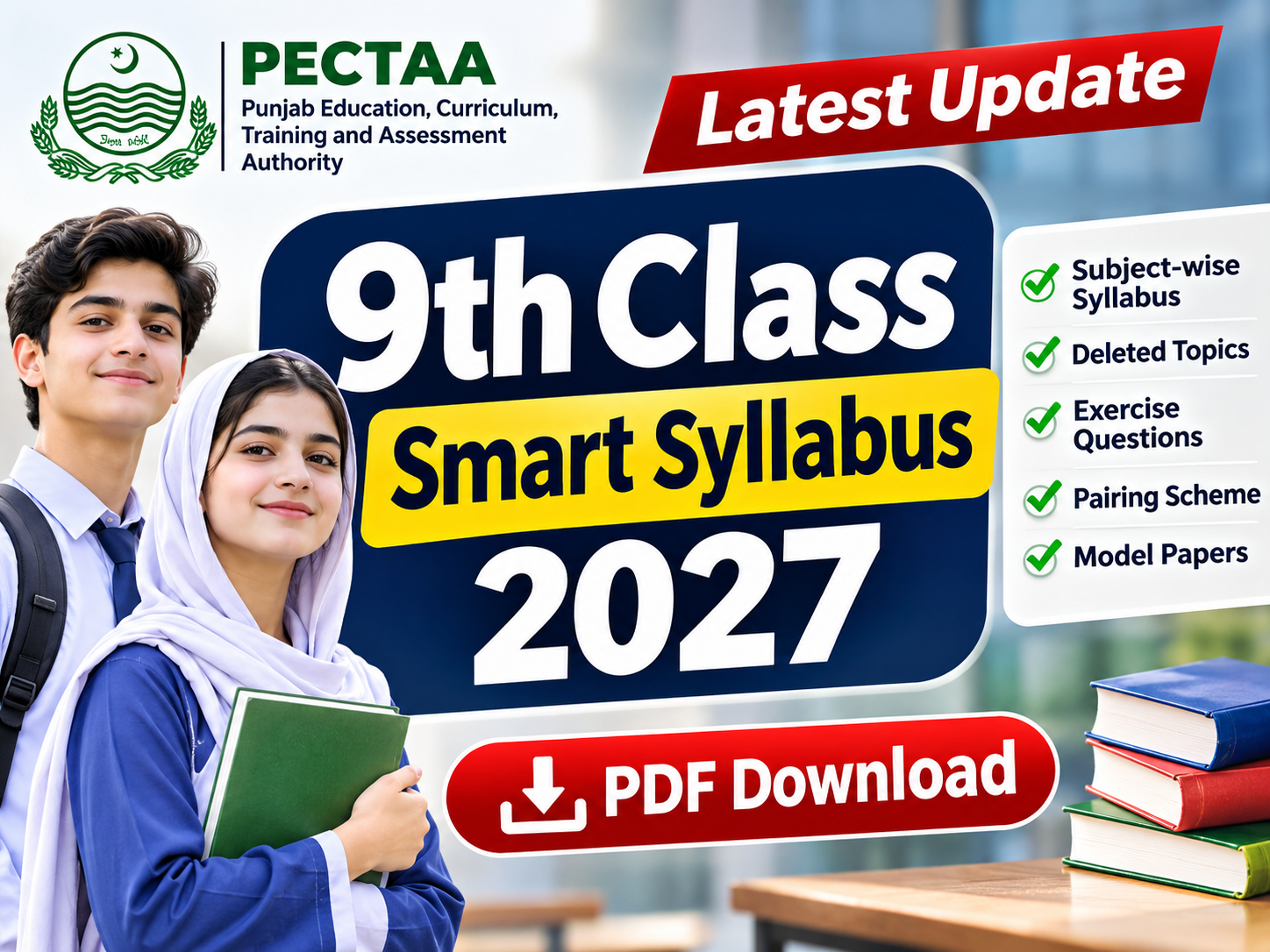
9th Class Smart Syllabus 2027 PDF Download Punjab Board – PECTAA
Students across Punjab are waiting for the latest 9th Class Smart Syllabus 2027. The Punjab Education, Curriculum, Training and Assessment Authority (PECTAA) is expected to release the updated smart syllabus for Class 9 on 7 November 2026, according to the announcement by Punjab Education Minister Rana Sikandar Hayat.
The new syllabus will help students prepare for the Punjab Board Annual Examinations 2027.
9th Class Smart Syllabus 2027 Latest Update
The Education Minister has announced that PECTAA will issue the smart syllabus for Classes 9, 10, 11 and 12. Students will be able to check the revised syllabus, deleted topics, exercise questions and other examination preparation materials after the official notification.
Download 9th Class Smart Syllabus 2027 PDF
The official 2027 Smart Syllabus PDF has not yet been published. We will add the subject-wise download links as soon as PECTAA releases the official documents.
What Will the 9th Class Smart Syllabus Include?
Students can expect the official notification to clarify the applicable examination syllabus and related preparation materials. These may include:
- Deleted chapters and topics
- Excluded exercise questions
- Revised pairing schemes
- Updated model papers
- Subject-wise examination guidelines
The exact details will be confirmed after the official 2027 notification.
9th Class English Smart Syllabus 2027
The 9th Class English Smart Syllabus 2027 will highlight the chapters, poems, lessons and exercise questions excluded from the Punjab Board Annual Examinations. Students should review the excluded topics carefully to understand which parts of the textbook are not included in the examination.
| Unit No. | Unit Name | Excluded Topics and Pages |
|---|---|---|
| 5 | Women Empowerment through Entrepreneurship | Entire Unit Excluded (Pages 58–71) |
| 8 | The Impact of Globalisation on Culture and Economy | Entire Unit Excluded (Pages 93–105) |
| 10 | The Silent Predator and the Majestic Prey – Snow Leopard and Markhor | Entire Unit Excluded (Pages 120–131) |
Important: Units 1, 2, 3, 4, 6, 7, 9 and 11 remain included in the English syllabus. Examination questions will be prepared from the included units and prescribed grammar and composition content.

9th Class Urdu Smart Syllabus 2027
The 9th Class Urdu Smart Syllabus 2027 will identify the deleted lessons, poems, prose sections and exercise questions. Students can check the excluded topics to focus their preparation on the prescribed syllabus for the 2027 annual examinations.
9th Class Mathematics Smart Syllabus 2027
The 9th Class Mathematics Smart Syllabus 2027 will provide details about excluded exercises, questions and topics from the textbook. Students should check the revised syllabus to identify the mathematics content required for the Punjab Board examinations.
| Chapter No. | Chapter Name | Excluded Topics and Exercise Questions |
|---|---|---|
| 1 | Real Numbers | Excluded Topics: 1.1 Introduction to Real Numbers (P. 1–3); 1.3 Applications of Real Numbers in Daily Life (P. 14–15); 1.3.1 Temperature Conversion, Example 10 (P. 15–16); 1.3.2 Profit and Loss, Examples 11–14 (P. 16–18). Excluded Exercises: Exercise 1.3 (Complete), P. 18–19. Review Exercise 1 (Revised): Q3, Q8–10 (P. 20). |
| 2 | Logarithms | Excluded Topics: 2.4 Laws of Logarithm, Examples 12–15 (P. 30–34). Excluded Exercises: Exercise 2.4 (Complete), P. 34–35. Review Exercise 2 (Revised): Q1 (iv, ix, x), Q6 (ii, iii), Q7–10 (P. 35–36). |
| 3 | Sets and Functions | Excluded Topics: Introduction (P. 37); 3.1 Mathematics as the Study of Patterns, Structures and Relationships (P. 37–39, before the basic definition of Set); Example 5 (P. 51); 3.3 Binary Relations, Examples 7–8 (P. 55–56); 3.3.1 Relation as Table, Ordered Pair and Graphs (P. 56–57); 3.3.2 Functions and its Domain and Range, Example 9 (P. 57–59); 3.3.3 Notation of Function (P. 59); 3.3.4 Linear and Quadratic Functions, Examples 10–11 (P. 59–60). Excluded Exercises: Exercise 3.2, Q9, Q11–13 (P. 54–55); Exercise 3.3 (Complete), P. 61. Review Exercise 3: Q1 (vii–x), Q10–16 (P. 62–64). |
| 4 | Factorization and Algebraic Manipulation | Excluded Topics: 4.4 Square Root of an Algebraic Expression, Examples 26–27 (P. 77–78); 4.4.1 Real World Problems of Factorization, Examples 28–30 (P. 78–79). Excluded Exercises: Exercise 4.4 (Complete), P. 79–80. Review Exercise 4: Q1 (vi), Q4–5 (P. 81). |
| 5 | Linear Equations and Inequalities | Excluded Topics: 5.3 Feasible Solution, Example 6 (P. 91–92); 5.3.2 Maximum and Minimum Values of a Function in the Feasible Solution, Example 7 (P. 93–94). Excluded Exercises: Exercise 5.2 (Complete), P. 94–95. Review Exercise 5 (Revised): Q1 (vii, ix, x), Q3–5 (P. 95–96). |
| 6 | Trigonometry | Excluded Topics: Example 12 (P. 109); 6.6 The Angle of Elevation and the Angle of Depression, Examples 19–20 (P. 118–119). Excluded Exercises: Exercise 6.3, Q10–12 (P. 111); Exercise 6.4, Q2 (vii, viii), Q3 (iii) (P. 113); Exercise 6.5, Q5, Q6, Q9 (P. 117–118); Exercise 6.6 (Complete), P. 120. Review Exercise 6 (Revised): Q1 (iii), Q3 (iii–vi), Q5–6 (P. 121–122). |
| 7 | Coordinate Geometry | Excluded Topics: 7.3 Applications of Coordinate Geometry in Real Life Situations, Examples 14–20 (P. 141–144). Excluded Exercises: Exercise 7.1, Q6, Q9–10 (P. 128); Exercise 7.2, Q2 (iii, iv), Q12–13 (P. 140–141); Exercise 7.3 (Complete), P. 144–145. Review Exercise 7: Q4–10 (P. 146). |
| 8 | Logic | Entire chapter is excluded. |
| 9 | Similar Figures | Excluded Topics: 9.4 Geometrical Properties of Polygon and Their Applications (P. 177); 9.4.1 Geometrical Properties of Regular Polygon (P. 177–178); 9.4.2 Geometrical Properties of Triangle (P. 178); 9.4.3 Geometrical Properties of Parallelogram, Example 13 (P. 178); 9.4.4 Applications of Polygon, Examples 14–18 (P. 179–181). Excluded Exercises: Exercise 9.1, Q8–9 (P. 166); Exercise 9.2, Q5, Q8 (P. 172); Exercise 9.4 (Complete), P. 182. Review Exercise 9 (Revised): Q1 (iv, vi–x), Q2, Q4, Q7–9 (P. 183–184). |
| 10 | Graphs of Functions | Excluded Topics: 10.2 Exponential Growth / Decay of a Practical Phenomenon through its Graph, Example 12 (P. 193–194); 10.2.1 Gradients of Curves by Drawing Tangents, Example 13 (P. 194); 10.2.2 Applications of Graph in Real Life, Examples 14–15 (P. 195–196). Excluded Exercises: Exercise 10.2 (Complete), P. 197. Review Exercise 10: Q3, Q5–7 (P. 199). |
| 11 | Loci and Construction | Excluded Topics: 11.5.2 Intersection of Loci, Examples 10–12 (P. 209–211); 11.6 Real Life Application of Loci (P. 211). Excluded Exercises: Exercise 11.2 (Complete), P. 212–213. Review Exercise 11 (Revised): Q1 (x), Q2–8 (P. 214). |
| 12 | Information Handling | Excluded Topics: 12.2.4 Weighted Mean, Examples 19–20 (P. 234–235). Excluded Exercises: Exercise 12.1, Q8 (P. 224); Exercise 12.2, Q11 (ii), Q13–20 (P. 238–239, Revised). Review Exercise 12: Q7, Q12 (P. 241–242). |
| 13 | Probability | Excluded Topics: 13.6 Expected Frequency, Example 11 (P. 255); 13.7 Real Life Application on Expected Frequency, Examples 12–13 (P. 255–256). Excluded Exercises: Exercise 13.2, Q5–8 (P. 257). Review Exercise 13 (Revised): Q1 (v), Q2 (ii), Q3–7 (P. 258–259). |
Important: The Mathematics Smart/Reduced Syllabus identifies specific deleted topics, examples, exercises and review-exercise questions. Students should prepare the remaining textbook content for the Annual Examination 2027.

9th Class Physics Smart Syllabus 2027
The 9th Class Physics Smart Syllabus 2027 will highlight the topics, numerical problems, exercises and other textbook content excluded from the examination syllabus. Students can use these details to organize their Physics preparation effectively.
| Chapter No. | Chapter Name | Excluded Topics and Exercise Questions |
|---|---|---|
| 1 | Physical Quantities & Measurements | Excluded Topics: 1.6 Mass Measuring Instruments (P. 16); 1.7 Time Measuring Instruments (P. 17); 1.8 Errors in Measurements (P. 18); 1.10 Uncertainty in a Measurement (P. 20); 1.12 Precision and Accuracy (P. 22). Excluded MCQs: 1.3, 1.6, 1.8, 1.11. Excluded Short Questions: 1.5, 1.8, 1.9, 1.10, 1.11. Excluded CRQs: 1.1, 1.2, 1.4, 1.8, 1.10. Excluded Comprehensive Questions: 1.3, 1.4, 1.5. Excluded Numericals: 1.2, 1.5, 1.7, 1.9. |
| 2 | Kinematics | Excluded Topics: 2.3 Types of Motion (P. 33); 2.8 Gradient of a Distance-Time Graph (P. 41); 2.10 Gradient of a Speed-Time Graph (P. 43). Excluded MCQs: 2.5, 2.6, 2.8, 2.9, 2.10. Excluded Short Questions: 2.6, 2.7, 2.8. Excluded CRQs: 2.1, 2.3, 2.4, 2.5. Excluded Comprehensive Questions: 2.3, 2.5, 2.7. Excluded Numericals: 2.5, 2.8, 2.10. |
| 3 | Dynamics | Excluded Topics: 3.2 Fundamental Forces (P. 55–56); 3.3 Forces in a Free-Body Diagram (P. 57); 3.5 Limitations of Newton’s Laws of Motion (P. 61); 3.7 Mechanical and Electronic Balances (P. 64–65). Excluded MCQs: 3.4, 3.7, 3.8. Excluded Short Questions: 3.7, 3.8, 3.10. Excluded CRQs: 3.3 (Revised). Excluded Comprehensive Questions: 3.6. Excluded Numericals: 3.5, 3.6, 3.8, 3.9. |
| 4 | Turning Effects of Force | Excluded Topics: 4.7 Centre of Gravity and Centre of Mass (P. 88–90); 4.11 Improvement of Stability (P. 95); 4.12 Applications of Stability in Real Life (P. 96–97). Excluded MCQs: 4.4, 4.5, 4.6, 4.8. Excluded Short Questions: 4.5, 4.6, 4.8, 4.9, 4.10. Excluded CRQs: 4.3, 4.5. Excluded Comprehensive Questions: 4.2, 4.4. Excluded Numericals: 4.2, 4.5, 4.6, 4.9, 4.10. |
| 5 | Work, Energy and Power | Excluded Topics: 5.4 Sources of Energy (P. 113–117); 5.6 Advantages and Disadvantages of Methods of Energy Production (P. 118). Excluded MCQs: 5.2, 5.4, 5.7. Excluded Short Questions: 5.3, 5.6, 5.10. Excluded CRQs: 5.2, 5.5, 5.8, 5.9. Excluded Comprehensive Questions: 5.3, 5.5. Excluded Numericals: 5.2, 5.5, 5.7, 5.8, 5.9, 5.12, 5.13. |
| 6 | Mechanical Properties of Matter | Excluded Topics: Applications of Hooke’s Law (P. 130); 6.7 Measurement of Atmospheric Pressure (P. 137–138); 6.8 Measurement of Pressure by Manometer (P. 138); Activities 6.1 and 6.6 (P. 129, 142). Excluded MCQs: 6.2, 6.4, 6.5. Excluded Short Questions: 6.2, 6.6, 6.9. Excluded CRQs: 6.1, 6.3, 6.4, 6.6, 6.7, 6.8, 6.9, 6.10 (Revised). Excluded Comprehensive Questions: 6.1 (Applications of Hooke’s Law excluded), 6.2, 6.5 (Revised). Excluded Numericals: 6.3, 6.8, 6.10, 6.11, 6.12. |
| 7 | Thermal Properties of Matter | Excluded Topics: 7.1 Kinetic Molecular Theory of Matter (P. 149–150); 7.4 Sensitivity, Range and Linearity of Thermometers (P. 155); 7.5 Structure of a Liquid-in-Glass Thermometer (P. 156). Excluded MCQs: 7.1, 7.2, 7.7, 7.10, 7.11. Excluded Short Questions: 7.1, 7.2, 7.3, 7.6, 7.9, 7.10, 7.11, 7.14, 7.15. Excluded CRQs: 7.1, 7.4, 7.5, 7.7, 7.8, 7.10, 7.11, 7.12 (Revised). Excluded Comprehensive Questions: 7.1, 7.4, 7.5. Excluded Numericals: 7.5, 7.6. |
| 8 | Magnetism | Excluded Topics: Applications of Permanent Magnets (P. 168); Magnetic Relay and Telephone Receiver (P. 170); 8.8 Domain Theory of Magnetism (P. 171); 8.9 Alignment of Domains (P. 172); 8.10 Applications of Magnets in Recording Technology (P. 173); 8.11 Soft Iron as Magnetic Shield (P. 175–177). Excluded MCQs: 8.3, 8.4, 8.6, 8.7, 8.8 (Revised). Excluded Short Questions: 8.5, 8.6, 8.7. Excluded CRQs: 8.3, 8.5. Excluded Comprehensive Questions: 8.5, 8.6. Excluded Numericals: Not specified. |
| 9 | Nature of Science | Excluded Topics: 9.4 Interdisciplinary Research (P. 186–187); 9.6 Scientific Base of Technology and Engineering (P. 190–191). Excluded MCQs: 9.4, 9.5, 9.7, 9.11. Excluded Short Questions: 9.3, 9.7, 9.8. Excluded CRQs: 9.5, 9.6, 9.8, 9.9, 9.10. Excluded Comprehensive Questions: 9.2, 9.4. Excluded Numericals: Not specified. |
Source: PECTAA Class 9 ALP Notification, 6 November 2026, Annex-A, pages 2–3.

9th Class Chemistry Smart Syllabus 2027
The 9th Class Chemistry Smart Syllabus 2027 will identify excluded chapters, topics, reactions and exercise questions. Students should review the official syllabus to understand which Chemistry topics are included in the 2027 annual examinations.
| Chapter No. | Chapter Name | Excluded Topics and Exercise Questions |
|---|---|---|
| 1 | States of Matter and Phase of Change | Excluded Topics: 1.2 States of Matter (P. 4–6); 1.4 Allotropic Forms of Substances (P. 8); 1.8 Effect of Temperature on the Solubility of Solutes (P. 11–13). Excluded MCQs: i, iv, vii, ix, x. Excluded Short Questions (SAQs): iii, v, iv, vii. Excluded CRQs: i, ii, iv, v, vi, vii, viii. Excluded Descriptive Questions (DQs): ii, iii, iv, v. Excluded Investigative Questions (IQs): ii. |
| 2 | Atomic Structure | Excluded Topics: 2.3 Isotopes and Their Masses (Radioactive Isotopes, Applications of Radioactive Isotopes, Ionization of Atoms by Radioactive Sources) (P. 24–26). Excluded MCQs: iii, iv, vii, x. Excluded Short Questions (SAQs): iv, v. Excluded CRQs: iv, v. Excluded Descriptive Questions (DQs): i, ii, iii, iv. Excluded Investigative Questions (IQs): i. |
| 3 | Chemical Bonding | Excluded Topics: 3.6 Compare the Properties of Ionic and Covalent Compounds (P. 44); 3.8 Nature of Bonding and Properties (P. 46–48). Excluded MCQs: v, ix. Excluded Short Questions (SAQs): ii, iv. Excluded CRQs: v, vi. Excluded Descriptive Questions (DQs): ii, iv, v. Excluded Investigative Questions (IQs): i, ii. |
| 4 | Stoichiometry | Excluded Topics: None separately specified. Excluded MCQs: viii, ix, x. Excluded Short Questions (SAQs): ii. Excluded CRQs: iv, v. Excluded Descriptive Questions (DQs): iii. Excluded Investigative Questions (IQs): i, ii. |
| 5 | Energetics | Excluded Topics: Partial part of 5.3 Exothermic and Endothermic Reactions (from last paragraph on P. 71–74). Excluded MCQs: vi, vii, ix, x. Excluded Short Questions (SAQs): iv. Excluded CRQs: i, iii. Excluded Descriptive Questions (DQs): i, iv. Excluded Investigative Questions (IQs): ii. |
| 6 | Equilibria | Excluded Topics: 6.3 Changing the Physical Conditions of a Chemical Reaction (P. 86–89). Excluded MCQs: iii, iv, vii, x. Excluded Short Questions (SAQs): ii, v. Excluded CRQs: iv, v. Excluded Descriptive Questions (DQs): iii, v. Excluded Investigative Questions (IQs): i, ii. |
| 7 | Acid Base Chemistry | Excluded Topics: 7.5 Acid Rain and Its Effects (P. 102). Excluded MCQs: vii, x. Excluded Short Questions (SAQs): v. Excluded CRQs: ii. Excluded Descriptive Questions (DQs): iv, v. Excluded Investigative Questions (IQs): i. |
| 8 | Periodic Table and Periodicity | Excluded Topics: 8.5 Metallic Character and Reactivity (P. 114–115). Excluded MCQs: viii, ix. Excluded Short Questions (SAQs): ix, x. Excluded CRQs: v. Excluded Descriptive Questions (DQs): iv, vi. Excluded Investigative Questions (IQs): ii. |
| 9 | Group Properties and Elements | Excluded Topics: 9.5 Physical Properties of Metals and Non-Metals (P. 124–125). Excluded MCQs: viii, ix. Excluded Short Questions (SAQs): v. Excluded CRQs: iii, vi, vii. Excluded Descriptive Questions (DQs): iii, vi. Excluded Investigative Questions (IQs): iii. |
| 10 | Environmental Chemistry | Excluded Topics: 10.4 Global Warming (Greenhouse Effect) (P. 136–139); 10.5 Strategies to Reduce Environmental Issues (P. 139–141). Excluded MCQs: i, iv, viii, ix. Excluded Short Questions (SAQs): ii, iii, vi, vii. Excluded CRQs: iii, iv, v. Excluded Descriptive Questions (DQs): ii, iii, iv, v. Excluded Investigative Questions (IQs): i, ii, iii. |
| 11 | Hydrocarbons | Excluded Topics: 11.4 Important Reactions (P. 151–153). Excluded MCQs: iii, vi, ix, x. Excluded Short Questions (SAQs): iii, viii, ix. Excluded CRQs: iv, v, vi. Excluded Descriptive Questions (DQs): iii, v. Excluded Investigative Questions (IQs): i. |
| 12 | Empirical Data Collection and Analysis | Entire chapter is deleted. |
| 13 | Laboratory and Practical Skills | Entire chapter is deleted. |
Important: All questions for the BISE examination will be prepared from the textbook content except the topics and questions excluded in the official Smart Syllabus (ALP).

9th Class Biology Smart Syllabus 2027
The 9th Class Biology Smart Syllabus 2027 will outline the excluded chapters, diagrams, topics and exercise questions. Students can review the revised syllabus to focus on the prescribed Biology content for their board examinations.
| Chapter No. | Chapter Name | Excluded Topics and Exercise Questions |
|---|---|---|
| 1 | The Science of Biology | Excluded Topics: 1.2 Relation of Biology with Other Sciences (P. 8–10); 1.3 Careers in Biology (P. 10–12); 1.5 Science as a Collaborative Field (P. 13–14); 1.8 Malaria – An Example of Biological Method (P. 17–20); Key Points (P. 21–22). Excluded MCQs: 9, 10 (P. 23). Excluded Short Questions: 3, 5 (P. 23). Excluded Long Questions: 1–3, 6–7 (P. 24). Excluded Inquisitive Questions: All (P. 24). |
| 2 | Biodiversity | Excluded Topics: Advantages of Classification (P. 27); Table (P. 28); History of Classification (P. 29); Table (P. 31); Table (P. 35); Box (P. 36); Key Points (P. 38). Excluded MCQs: 8–10 (P. 39). Excluded Short Questions: 1, 2, 4 (P. 40). Excluded Long Questions: 1, 2 (P. 40). Excluded Inquisitive Questions: All (P. 40). |
| 3 | The Cell | Excluded Topics: Side Box and Table (P. 52); Table (P. 53); 3.3 Structural Advantages of Plant and Animal Cells (P. 53–54); Division of Labour Within and Across Cells (P. 56–57); Key Points (P. 59). Excluded MCQs: 4, 11, 14 (P. 60–61). Excluded Short Questions: 4, 10, 14 (P. 61). Excluded Long Questions: 8, 9 (P. 62). Excluded Inquisitive Questions: All (P. 62). |
| 4 | Cell Cycle | Excluded Topics: Box (P. 65); 4.4 Comparison Between Meiosis and Mitosis (P. 73–75); Key Points (P. 76). Excluded MCQs: 3, 8 (P. 77). Excluded Short Questions: 8, 10 (P. 78). Excluded Long Questions: 2 (P. 78). Excluded Inquisitive Questions: All (P. 78). |
| 5 | Tissues, Organs and Organ System | Excluded Topics: Emergent Properties (P. 81–82); Role of Organ System in Homeostasis (P. 89); Key Points (P. 90). Excluded MCQs: 1, 3, 7 (P. 90–91). Excluded Short Questions: 5, 7 (P. 92). Excluded Long Questions: 6, 9, 10 (P. 92). Excluded Inquisitive Questions: All (P. 92). |
| 6 | Biomolecules | Excluded Topics: Key Points (P. 105–106). Excluded MCQs: 1, 8 (P. 106–107). Excluded Short Questions: 1, 4 (P. 108). Excluded Long Questions: 6 (P. 108). Excluded Inquisitive Questions: All (P. 108). |
| 7 | Enzymes | Excluded Topics: Key Points (P. 116). Excluded MCQs: 1, 4 (P. 117). Excluded Short Questions: 2, 5 (P. 118). Excluded Long Questions: 4 (P. 118). Excluded Inquisitive Questions: All (P. 118). |
| 8 | Bioenergetics | Excluded Topics: Use of Respiratory Energy in Body (P. 128); Table (P. 128); Table (P. 129); Figure 8.8 (P. 129); Key Points (P. 130). Excluded MCQs: 3, 9 (P. 131). Excluded Short Questions: 3, 7, 8, 9, 13 (P. 132). Excluded Long Questions: 3, 6 (P. 132). Excluded Inquisitive Questions: All (P. 132). |
| 9 | Plant Physiology | Excluded Topics: Roles of Nitrogen and Magnesium (P. 135); Key Points (P. 148). Excluded MCQs: 4, 7 (P. 149). Excluded Short Questions: 1, 3 (P. 150). Excluded Long Questions: 3, 8 (P. 150). Excluded Inquisitive Questions: All (P. 150). |
| 10 | Reproduction in Plants | Excluded Topics: Key Points (P. 163). Excluded MCQs: 4, 10 (P. 164). Excluded Short Questions: 3, 10 (P. 165–166). Excluded Inquisitive Questions: All (P. 166). |
| 11 | Biostatistics | Entire chapter is deleted (P. 167–175). |
| — | Glossary | Completely deleted (P. 176–180). |
Important: All types of questions for the BISE examination will be prepared from the textbook content except the topics and questions excluded in the official Biology Smart Syllabus (ALP).

9th Class Computer Science Smart Syllabus 2027
The 9th Class Computer Science Smart Syllabus 2027 will provide information about excluded chapters, programming topics and textbook exercises. Students should check the official syllabus to identify the content required for the 2027 examinations.
9th Class General Science Smart Syllabus 2027
The 9th Class General Science Smart Syllabus 2027 will highlight excluded topics, chapters and exercise questions. Students can use the updated syllabus to identify the prescribed content for their Punjab Board annual examinations.
9th Class Islamiat Smart Syllabus 2027
The 9th Class Islamiat Smart Syllabus 2027 will identify the lessons, topics and exercise questions excluded from the examination syllabus. Students should follow the official PECTAA guidelines when preparing for their annual examinations.
9th Class Tarjuma Tul Quran Smart Syllabus 2027
The 9th Class Tarjuma Tul Quran Smart Syllabus 2027 will provide details about the prescribed content and excluded topics. Students should review the official syllabus to prepare the relevant Quranic lessons and exercises for the 2027 examinations.
Is the 2026 Smart Syllabus the Same as the 2027 Syllabus?
Students should not assume that the previous year’s smart syllabus will automatically apply to the 2027 examinations. The previous Class 9 smart syllabus was specifically issued for the Annual Examination 2026.
Students should wait for the new PECTAA notification before skipping any chapters or topics.
Frequently Asked Questions
1. When will the 9th Class Smart Syllabus 2027 be released?
According to the Education Minister’s announcement, PECTAA is expected to release it on 7 November 2026.
2. Where can I download the 9th Class Smart Syllabus 2027 PDF?
Students can check the official PECTAA website. Subject-wise PDF links will be added to this page after publication.
3. Will the 2027 smart syllabus be different from 2026?
The changes will be confirmed once PECTAA publishes the new notification.
4. Does the smart syllabus apply to all Punjab Boards?
The previous PECTAA smart syllabus notifications were issued for implementation across Punjab. Students should follow the latest official notification for 2027.
Final Words
Keep visiting this page for the latest 9th Class Smart Syllabus 2027 PDF, subject-wise downloads, deleted topics, pairing schemes and model papers. We will update the download links as soon as the official syllabus becomes available.
Share this update with your classmates so they can also access the latest syllabus information.