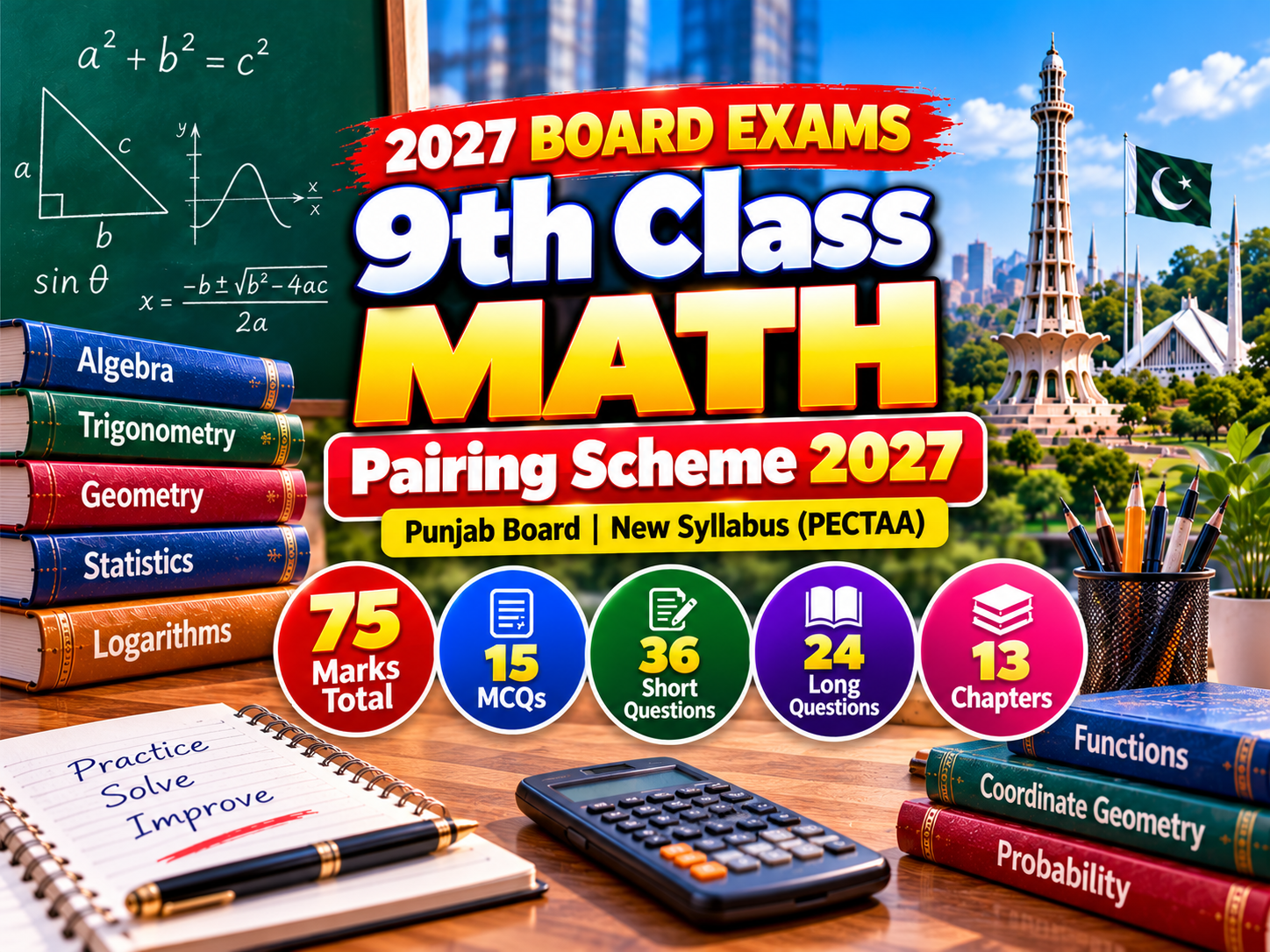
9th Class Math Pairing Scheme 2027, Punjab Board New Syllabus
The 9th Class Math Pairing Scheme 2027 explains the chapter-wise distribution of MCQs, short questions and long questions for students preparing for the Punjab Board Annual Exams 2027. It follows the new Punjab syllabus and curriculum framework associated with the Punjab Education, Curriculum, Training and Assessment Authority (PECTAA).
The Mathematics paper carries 75 marks and covers 13 chapters. Students can use this pairing scheme to organize revision and understand the distribution of questions across the syllabus.
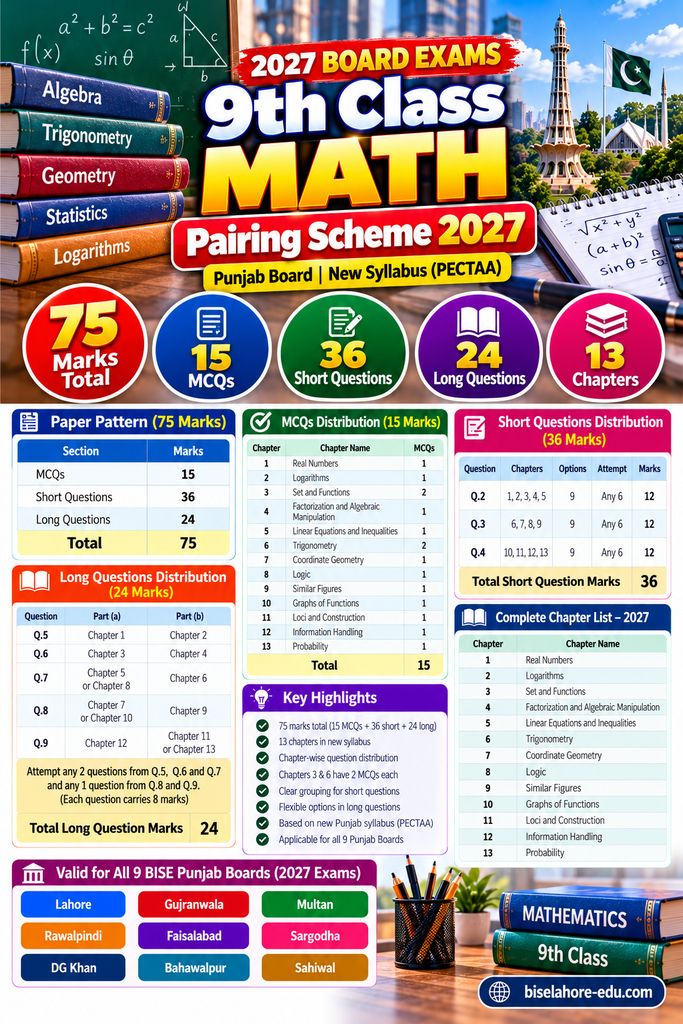
9th Class Math Paper Pattern 2027
| Section | Marks |
|---|---|
| MCQs | 15 |
| Short Questions | 36 |
| Long Questions | 24 |
| Total | 75 |
9th Class Math MCQs Distribution 2027
The objective section contains 15 MCQs. Chapters 3 and 6 have two MCQs each, while the remaining chapters have one MCQ each.
| Chapter | Chapter Name | MCQs |
|---|---|---|
| 1 | Real Numbers | 1 |
| 2 | Logarithms | 1 |
| 3 | Set and Functions | 2 |
| 4 | Factorization and Algebraic Manipulation | 1 |
| 5 | Linear Equations and Inequalities | 1 |
| 6 | Trigonometry | 2 |
| 7 | Coordinate Geometry | 1 |
| 8 | Logic | 1 |
| 9 | Similar Figures | 1 |
| 10 | Graphs of Functions | 1 |
| 11 | Loci and Construction | 1 |
| 12 | Information Handling | 1 |
| 13 | Probability | 1 |
| Total | 15 |
Students should give extra attention to Chapter 3, Set and Functions, and Chapter 6, Trigonometry, for MCQ preparation. However, all chapters should be revised because they also contribute to the subjective portion.
Short Questions Distribution
The short-question section carries 36 marks. It contains three groups, each with nine available questions. Students attempt any six from each group.
| Question | Chapters | Options | Attempt | Marks |
|---|---|---|---|---|
| Q.2 | 1, 2, 3, 4, 5 | 9 | Any 6 | 12 |
| Q.3 | 6, 7, 8, 9 | 9 | Any 6 | 12 |
| Q.4 | 10, 11, 12, 13 | 9 | Any 6 | 12 |
| Total | 27 | 18 | 36 |
Prepare the chapters according to their respective question groups. Practice formulas, calculations, algebraic steps and relevant mathematical concepts from the textbook.
Long Questions Distribution
The supplied pairing scheme lists five long-question choices, divided into two groups. Students are instructed to attempt any two questions from Q.5, Q.6 and Q.7, followed by any one question from Q.8 and Q.9.
| Question | Part (a) | Part (b) |
|---|---|---|
| Q.5 | Chapter 1 | Chapter 2 |
| Q.6 | Chapter 3 | Chapter 4 |
| Q.7 | Chapter 5 or Chapter 8 | Chapter 6 |
| Q.8 | Chapter 7 or Chapter 10 | Chapter 9 |
| Q.9 | Chapter 12 | Chapter 11 or Chapter 13 |
Long Question Marks
| Selection | Marks |
|---|---|
| Any 2 from Q.5, Q.6 and Q.7 | 16 |
| Any 1 from Q.8 and Q.9 | 8 |
| Total | 24 |
Each selected long question carries 8 marks according to the supplied distribution. Check the original scheme to confirm the question-selection instructions before relying on them for exam preparation.
Complete Chapter List for 9th Class Math 2027
The new Mathematics syllabus includes these 13 chapters:
| Chapter | Topic |
|---|---|
| 1 | Real Numbers |
| 2 | Logarithms |
| 3 | Set and Functions |
| 4 | Factorization and Algebraic Manipulation |
| 5 | Linear Equations and Inequalities |
| 6 | Trigonometry |
| 7 | Coordinate Geometry |
| 8 | Logic |
| 9 | Similar Figures |
| 10 | Graphs of Functions |
| 11 | Loci and Construction |
| 12 | Information Handling |
| 13 | Probability |
PECTAA 9th Class Math Pairing Scheme 2027
The 9th Class Math Pairing Scheme 2027 follows the new Punjab syllabus and curriculum framework associated with the Punjab Education, Curriculum, Training and Assessment Authority (PECTAA).
Students should use the scheme alongside the prescribed Class 9 Mathematics textbook. It provides a useful overview of the question distribution, but students should not completely skip chapters based only on their MCQ allocation.
9th Class Math Pairing Scheme for All Punjab Boards
The supplied scheme covers the following nine Punjab Boards for the 2027 examinations:
- BISE Lahore
- BISE Gujranwala
- BISE Multan
- BISE Rawalpindi
- BISE Faisalabad
- BISE Sargodha
- BISE DG Khan
- BISE Bahawalpur
- BISE Sahiwal
How to Prepare for the 9th Math Board Exam 2027
The 9th Class Math Pairing Scheme 2027 can help you organize your preparation according to the paper pattern, chapter distribution, and marks allocated to different question types. However, do not rely on the pairing scheme alone. Prepare the concepts, formulas, examples, and exercises from all 13 chapters of the new Punjab syllabus.
1. Prepare MCQs Chapter by Chapter
The objective section carries 15 marks, so regular practice can make a real difference to your total score. Chapters 3 (Set and Functions) and 6 (Trigonometry) carry two MCQs each according to the provided distribution. Chapters 1, 2, 4, 5, 7, 8, 9, 10, 11, 12, and 13 carry one MCQ each.
Revise definitions, mathematical symbols, formulas, properties, and basic concepts from every chapter. Solve the MCQs given in your textbook exercises and review the questions you answer incorrectly. Keep a separate notebook for important formulas and commonly confused concepts so you can revise them quickly before the examination.
2. Practice Short Questions from All Three Groups
The short-question section carries 36 marks. Questions are divided into three groups:
- Q.2: Chapters 1, 2, 3, 4, and 5
- Q.3: Chapters 6, 7, 8, and 9
- Q.4: Chapters 10, 11, 12, and 13
According to the provided scheme, each group offers nine questions, from which you attempt six. This choice gives you some flexibility, but you should not completely skip any chapter. A chapter with only one MCQ can still contribute several marks through short or long questions.
Practice the textbook exercises for each chapter group. Focus on solving questions independently rather than simply reading their solutions. Show the necessary steps, write the correct formulas, and keep your calculations organized. If you repeatedly make mistakes in a particular type of question, mark it for extra practice.
3. Give Special Attention to Long Questions
Long questions carry 24 marks, making them an important part of your preparation. The provided pairing scheme groups them as follows:
- Q.5: Chapters 1 and 2
- Q.6: Chapters 3 and 4
- Q.7: Chapter 5 or Chapter 8, along with Chapter 6
- Q.8: Chapter 7 or Chapter 10, along with Chapter 9
- Q.9: Chapter 12, along with Chapter 11 or Chapter 13
The stated selection pattern is to attempt any two questions from Q.5, Q.6, and Q.7, followed by any one question from Q.8 and Q.9. Check the original pairing scheme or your teacher’s guidance to confirm the exact choices and question structure before relying on them.
Practice complete long questions from every group. Learn the methods needed to solve them, understand why each step is used, and check your final answers. For geometry and construction questions, practice drawing neat diagrams with the correct labels and instruments. For algebra and trigonometry, revise the relevant identities, formulas, and solution methods.
4. Follow a Realistic Daily Study Plan
A consistent routine is more useful than trying to cover the entire syllabus in the final few days. Divide your available study time between concept revision, written practice, and checking mistakes.
For example, you can use this routine on a day when you have around two hours for mathematics:
- 30 minutes: Revise concepts and formulas from one chapter.
- 40 minutes: Solve short questions and textbook exercises.
- 35 minutes: Practice MCQs and selected long questions.
- 15 minutes: Check your answers and revise mistakes.
Adjust the routine according to your school schedule and the chapters you find difficult. Give additional time to topics that need more practice, and revisit previously studied chapters regularly so you do not forget them.
5. Solve Past Papers and Practice with a Timer
Past papers help you understand how mathematical concepts are tested in board examinations. Start by solving individual question groups, then move on to complete papers under timed conditions. After each practice paper, check your answers and identify where you lost marks.
Do not focus only on finishing quickly. Aim for accurate calculations, correct formulas, clear working, and answers that match the question. During the examination, follow the time limit and instructions printed on the actual paper. Avoid assuming a fixed time allocation for MCQs, short questions, or long questions unless your board or teacher has confirmed it.
6. Understand SLO-Based Questions
SLO-based questions assess whether you understand and can apply mathematical concepts. Memorizing a solved example may help you recognize a familiar question, but it may not prepare you for a problem presented in a different way.
For each chapter, understand the main concept, practice the textbook examples, and solve related exercise questions without looking at the solution. Try explaining the method in your own words. When you get a question wrong, identify whether the problem was a misunderstanding of the concept, an incorrect formula, or a calculation error.
7. Avoid Common Mistakes
Several small mistakes can reduce your marks even when you understand the topic. Keep these points in mind:
- Do not ignore chapters simply because they carry fewer MCQs.
- Write the formula or relevant mathematical steps clearly.
- Check signs, brackets, fractions, powers, and arithmetic calculations.
- Draw and label geometry diagrams neatly wherever required.
- Read each question carefully before choosing a method.
- Practice enough questions to become comfortable solving them independently.
- Leave time to review your answers and correct avoidable errors.
Attempt every question you are required to answer, and show your working wherever appropriate. Clear steps can help the examiner understand your method, even if you make an error in the final calculation.
Frequently Asked Questions
What are the total marks for 9th Class Mathematics in 2027?
The Mathematics paper carries 75 marks, including 15 marks for MCQs, 36 for short questions and 24 for long questions.
How many MCQs are included in the 9th Math paper?
The objective section contains 15 MCQs, carrying one mark each.
Which chapters have two MCQs?
According to the supplied distribution, Chapter 3, Set and Functions, and Chapter 6, Trigonometry, each have two MCQs.
How many short questions must students attempt?
Students attempt six questions from each of the three groups, giving 18 attempted short questions worth 36 marks.
How many marks are allocated to long questions?
The long-question section carries 24 marks. The supplied scheme describes a selection of two questions from Q.5–Q.7 and one from Q.8–Q.9.
Is this pairing scheme valid for all Punjab Boards?
The supplied scheme lists all nine BISE Punjab boards. Students should check their board’s latest examination instructions for confirmation.
Is the scheme based on the new syllabus?
The supplied scheme is presented as being based on the new Punjab Mathematics syllabus and curriculum framework associated with PECTAA.
Final Update
The 9th Class Math Pairing Scheme 2027 provides a chapter-wise overview of the objective, short-question and long-question sections. Use it to organize your revision, practice mathematical problems and prepare from the complete prescribed textbook.