
10th Class English Pairing Scheme 2027, Punjab Board
The 10th Class English Pairing Scheme 2027 explains the distribution of objective, short and subjective questions for students preparing for the Punjab Board Annual Exams 2027. The scheme follows the new Punjab syllabus and curriculum framework associated with PECTAA.
The paper carries 75 marks and covers Units 1 to 10 along with Review I and Review II.
10th Class English Paper Pattern 2027
| Section | Marks |
|---|---|
| Objective | 19 |
| Short Questions | 10 |
| Subjective | 46 |
| Total | 75 |
The paper includes objective questions, short questions, translation, poetry, essay or paragraph writing, grammar and other written components.
10th Class English Objective / MCQs Distribution 2027
The objective portion carries 19 marks and includes grammar, vocabulary and textbook-based questions.
| Part | Description | Marks |
|---|---|---|
| A | Correct Forms of Verbs | 5 |
| B | Correct Spellings | 4 |
| C | Meanings of Underlined Words | 5 |
| D | Grammar Options | 5 |
| Total | 19 |
The spelling section covers Units 1 to 5 with Review-I and Units 6 to 10 with Review-II. Meanings of underlined words are also divided between the two groups of units.
Students should revise grammar and vocabulary exercises from the complete syllabus rather than focusing on only a few units.
Short Questions Distribution
The short-question section carries 10 marks. Students have eight options in each group and attempt five.
| Question | Units | Options | Attempt | Marks |
|---|---|---|---|---|
| Q.2 (i–iv) | Units 1–5 + Review-I | 8 | Any 5 | 5 |
| Q.2 (v–viii) | Units 6–10 + Review-II | 8 | Any 5 | 5 |
| Total | 10 | 10 |
Students should prepare important textbook questions, concepts and vocabulary from both groups.
Subjective Section Distribution
The subjective section carries 46 marks and tests translation, poetry, writing and grammar skills.
| Question | Description | Marks |
|---|---|---|
| Q.3 | Translate 1 of 2 paragraphs into Urdu or rewrite it in simple English | 8 |
| Q.4 | Write the poem summary or explain a stanza with reference to context | 5 |
| Q.5 | Essay of 150–200 words or paragraph of 100–150 words | 15 |
| Q.6 | Change any 5 of 8 sentences into indirect speech | 5 |
| Q.7 | Use any 5 of 8 pairs of words in sentences | 5 |
| Q.8 | Translate an Urdu paragraph into English or write a 10-sentence paragraph for English-medium candidates | 8 |
| Total | 46 |
Q.3 Translation
The paragraphs are divided into two groups:
- Paragraph 1: Units 1, 3, 4 and 5
- Paragraph 2: Units 6, 8 and 10
Students are given a choice between the paragraphs and the specified alternative.
Q.5 Essay and Paragraph
Students get a choice between:
- An essay of 150–200 words, or
- A paragraph of 100–150 words
The question provides three topics for each option.
10th Class English Units 2027
The new Class 10 English syllabus includes the following units:
| Unit | Title |
|---|---|
| 1 | Hazrat Muhammad’s (ﷺ) Social Reforms for the Rights of Women, Orphans and Slaves |
| 2 | My Beloved Pakistan |
| 3 | Digital Globalisation Transforming the English Language |
| 4 | The Earth: Act Now for Tomorrow |
| 5 | The Happy Prince |
| 6 | Drug Abuse |
| 7 | Time |
| 8 | Pollution-Free Pakistan with Greenery All Around |
| 9 | The Road Not Taken |
| 10 | The Three Questions |
The syllabus also includes Review-I after Unit 5 and Review-II after Unit 10.
PECTAA 10th Class English Pairing Scheme 2027
The 10th Class English Pairing Scheme 2027 follows the new Punjab syllabus and curriculum framework associated with the Punjab Education, Curriculum, Training and Assessment Authority (PECTAA).
Students should use the pairing scheme together with the prescribed Class 10 English textbook and other relevant preparation material. The scheme helps students understand the distribution of different question types across the syllabus.
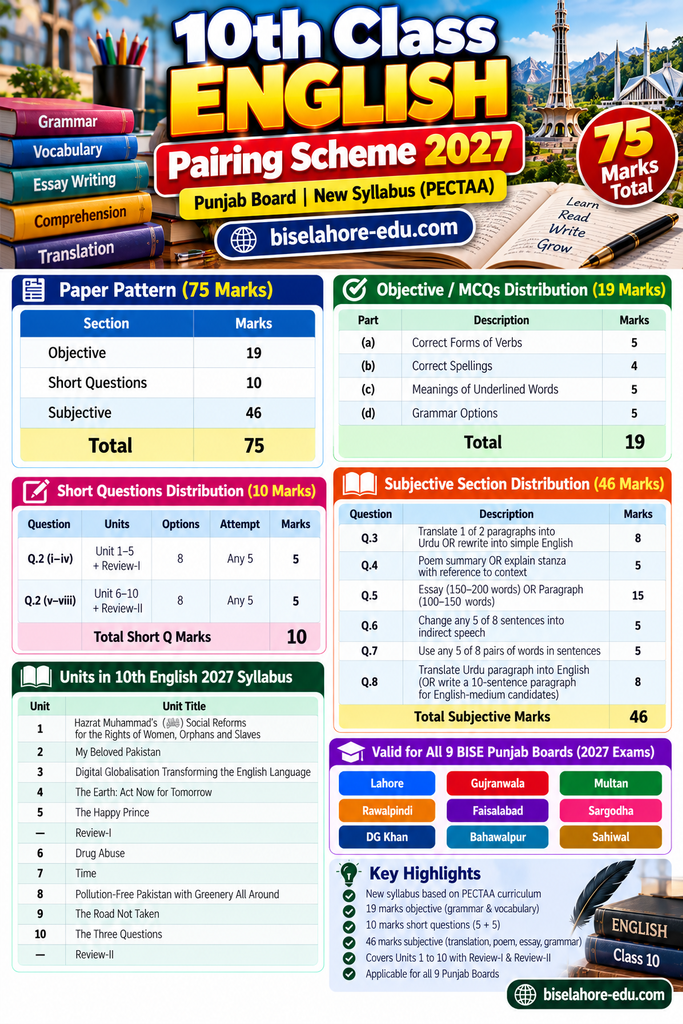
10th Class English Pairing Scheme for All Punjab Boards
The provided scheme covers the nine BISE Punjab boards for the 2027 examinations:
- BISE Lahore
- BISE Gujranwala
- BISE Multan
- BISE Rawalpindi
- BISE Faisalabad
- BISE Sargodha
- BISE DG Khan
- BISE Bahawalpur
- BISE Sahiwal
How to Prepare for 10th English Board Exam 2027
Start by preparing the complete textbook rather than skipping units. Give special attention to grammar, spellings, vocabulary and meanings because they form an important part of the objective section.
For short questions, revise the important questions and concepts from both unit groups. Practice translation regularly and prepare the poems for both summary and stanza explanation.
Essay and paragraph writing should also be practiced within the required word limits. Revise direct and indirect speech and prepare common pairs of words with correct sentence usage.
Solving previous board papers and model papers can help students understand the question format and improve their writing speed.
Frequently Asked Questions
What is the total marks of 10th Class English in 2027?
The Class 10 English paper carries 75 marks.
How many marks are in the objective portion?
The objective section carries 19 marks.
How many short questions are attempted?
Students attempt 10 short questions, carrying a total of 10 marks.
How many marks are allocated to the subjective section?
The subjective section carries 46 marks.
Which units are included in the Class 10 English 2027 syllabus?
The syllabus contains 10 units, from Hazrat Muhammad’s Social Reforms to The Three Questions, along with Review-I and Review-II.
Is this pairing scheme valid for all Punjab Boards?
The provided scheme covers the nine BISE Punjab boards for the 2027 examinations.
Is the scheme based on the new syllabus?
Yes. It follows the new Class 10 English syllabus and curriculum framework associated with PECTAA.
Final Update
The 10th Class English Pairing Scheme 2027 provides students with a clear overview of the 75-mark paper, including the objective section, short questions, translation, poetry, writing and grammar components.
Students should use the pairing scheme as a preparation guide while continuing to study the complete prescribed textbook.